1.Briefly describe the context of your project and how you used a range of critical perspectives and approaches to initiate your idea.
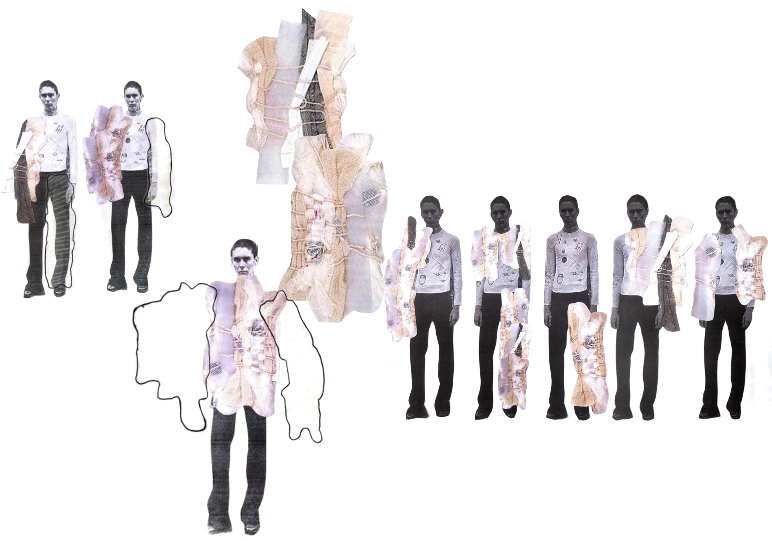
Having been effected by acne when I was younger I have always been very aware of others with this. When deciding what I wanted to do for my FMP I felt strongly that using this as a basis of designing a garment that people lacking in confidence due to acne and other skin conditions I could create something that would link to this. At the same time create something that would make them feel comfortable and confident wearing. Acne is seen often as an unpleasant skin condition but is hugely common and something I wanted to bring to the fore and highlight that it shouldn’t be seen this way and looked to portray this through my design.
2. Describe how research, analysis and evaluation helped you to feed ideas and develop concepts?
Having seen the very striking collection of images ‘Epidermis’ from the photographer Sophie Harris-Taylor I found it very refreshing to see someone who has been known and awarded for her portrait photography undertake a study on the highly sensitive and much talked about subject of body positivity particularly how we view imperfection. She took a series of close up photographs of women with varying skin conditions. Naked and make up free. In doing so her aim was to break down the stigmas surrounding skin issues to celebrate diversity. This was my springboard in my research that led me to take this further in creating a garment that championed the positives from this. Other types of research I used was visiting a number of gallery exhibitions – a few of note are the Fashion in Motion & Textile exhibition at Messums Wiltshire and also the Dior exhibition at the V&A to look at the way that fabrics and textiles have been viewed through time and how that relates from the past up to modern day and couture. Alongside this I spent time researching medical journals and dermalogical images to progress the way I designed the background pattern and textures in the final garment design.
3. What specialist skills and methods did you use to realise your project?
During my design stages I experimented with various skills – creating different weaves with a selection of medical materials and also creating some sketch designs with Photoshop in a series of digital muse images. Following my experiments with the weaving I decided to try creating some further design prints using the heat press on various different fabrics. From this I was able to establish the most suitable fabrics to use in my final garment design.
4. How did you integrate practical, theoretical and technical understanding to solve complex problems within your FMP? Please use examples.
During my FMP I carried out a survey from an online questionnaire I created and collated research from 15 individuals. Also the weaving I did was a new skill to me that was self taught although I did review a couple of YouTube videos to understand the best way to achieve this with a selection of different textiles. Another element I particularly learnt from during my research processes was the way in which you can print onto differently textured fabrics – sometimes that work well and some that had a very negative effect on the overall finish but a useful exercise of my research for me to understand which ultimately would work in the correct way to achieve the right finish visually.
5. What systems/ tools did you use to plan your project and how effective were they to organise and develop your work?
During my project I carried out a weekly blog that helped me to keep to my schedule and be able to update both my teachers and myself of the progress I was making and also feedback for myself of how things were progressing. Alongside this I had a daily personal calendar with bullet points as notes.
6. What type of evaluative and reflective records did you keep? How did this help you develop your learning? Please use examples.
Every morning throughout my FMP I made daily ‘To Do’ lists as quick reference guides for my daily work schedule. Also I had weekly tutorial crits that helped me to progress my work.
7. Who is your intended audience? Describe techniques and methods you used to communicate your idea to them.
My intended audience is gender neutral and predominantly for people experiencing acne. As I moved through my research stages I felt ultimately and having mentioned previously having seen the positive images of Sophie Harris-Taylor and my research images of skin conditions that it is something that effects not just teenagers but I felt I needed to design a garment that worked with the younger generation [16-30]
8. Overall summary: Describe the key points to take away from this experience. In what ways will your approach to creative production change in future as a result
Key areas that I have learnt from during this process is that I am even more mindful of how fabrics and garments are designed for individuals that don’t have a huge amount of confidence. Also how important fabrics are and feel against skin particularly of those who have sensitive skin. Another element that I have learnt from going forward is how important and also tricky it is to create particular patterns on fabric. The way the pattern is ultimately visualised both close up and from afar. Although I am pleased with the outcome of my final garment I would have liked the pattern to be a little more visible in the final piece perhaps which is not obvious from afar.
 OPB_ Fashion